
How can an immersive experience such as VR contribute to preparing children aged 8 to 10 for their (anesthesia) treatment?
Children can experience surgery in a hospital as a traumatic experience that they remember for the rest of their lives. As a result, some adults tend to avoid hospital visits because of negative feelings associated with hospitals that developed in childhood. That’s why it is especially important to provide children with a positive and reassuring experience during their surgery.
Date: 1-2-2025 t/m 16-6-2025
Client: Erasmus MC – Create 4 Care
Grade: 8
Target group
Elderly people between the ages of 65 and 75 who are in the early stages of Alzheimer’s.
We were given the opportunity to select a target group ourselves. In doing so, I wanted to challenge myself by choosing a group outside my comfort zone.
In the Netherlands, there are an estimated half a million people living with dementia. For elderly people with dementia and their carers, it can be difficult to engage in activities, which often leads to feelings of loneliness. That is why our team chose this target group.
At the moment, the museum offers a “Verwonder Tour” in which older visitors discuss paintings around a specific theme. However, this program has not been very successful, as it is often difficult to find a topic and conversation style that keeps the group of older participants engaged.
Current Situation
Different elements play a role in the preoperative anxiety that children experience. For example, children may find it stressful to give up control. They may also lack a clear expectation of what will happen, which can create tension. Hospitals have already introduced many initiatives to help both parents and children prepare for treatment. For instance, there are books, websites, and apps available to support children in their preparation. There is also being experimented with virtual Reality (VR), and it’s already used as preparation or distraction. However, this is still applied on a very small scale.
Design proces

Research
During this period, I mainly focused on the target group: children with little or no experience of being in a hospital. To explore this, I organized a creative session with four children where we talked about the image they have of the hospital. We did this by drawing and writing everything that came to their minds on large sheets of paper. It became clear that their perception of hospitals was largely based on what they had seen and heard in their surroundings, like someone in there klas that broke a arm.
The children also came up with their own inventions designed to comfort kids in hospitals. Most of these ideas involved toys stuffed animals, but many also centered around family and friends. I was able to combine this research with interviews with experts, such as a child pedagogue from the Sophia Children’s Hospital, as well as existing research conducted by Erasmus MC.
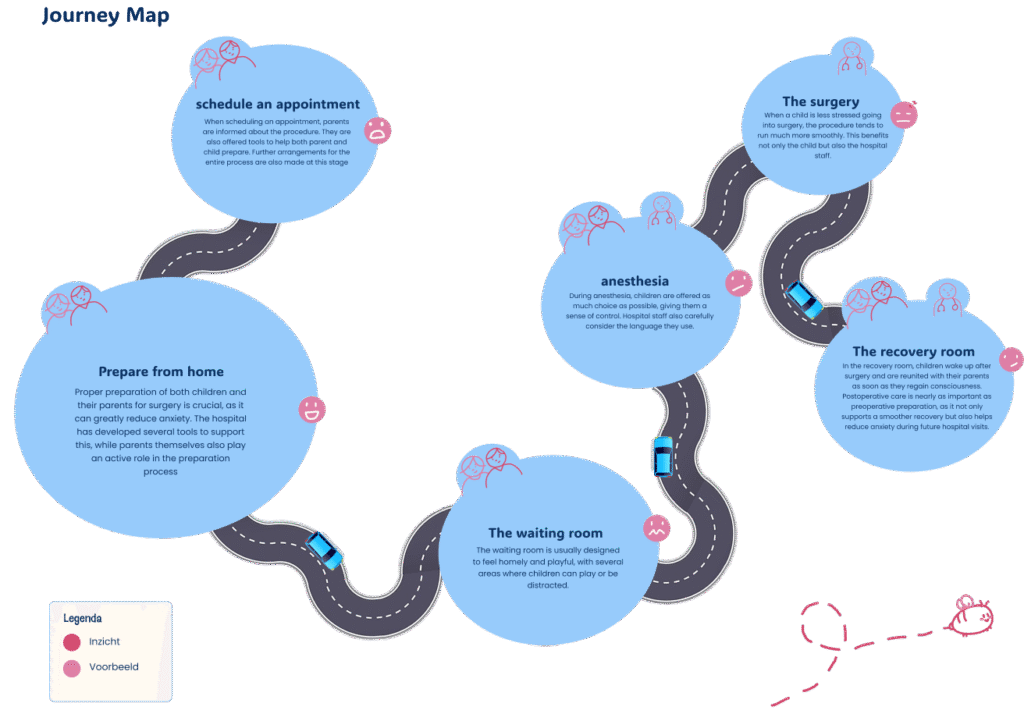
This image shows the roadmap I created to map out the current situation from start to finish.
Creative concepting
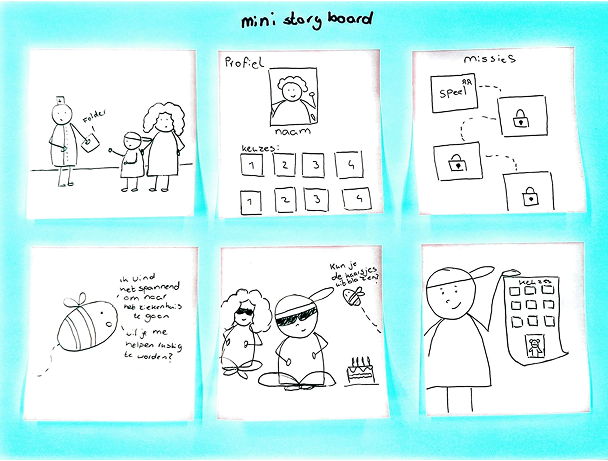
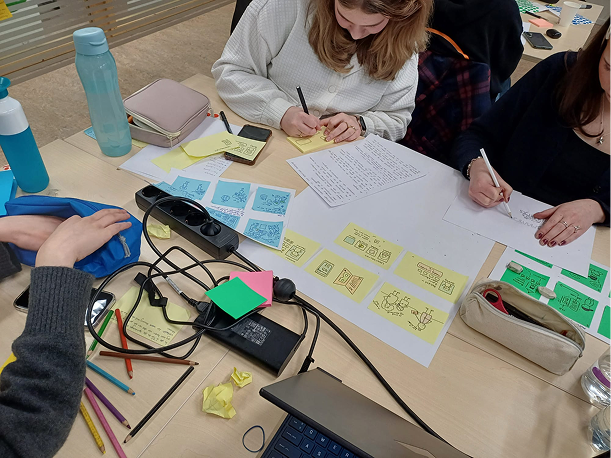
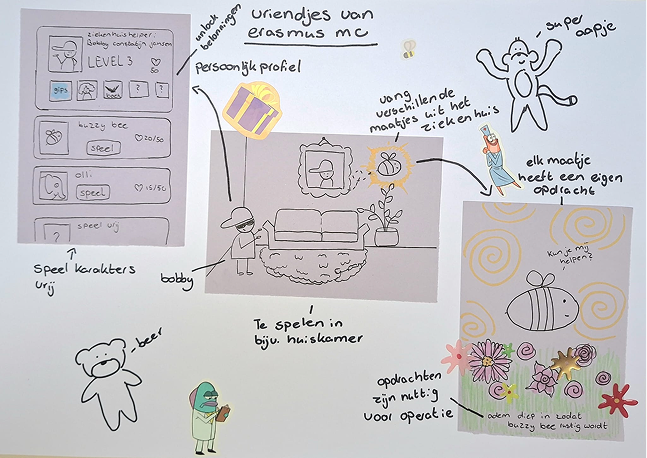
After conducting research, we organized a creative session. As the decider, I took the lead in applying various creative techniques. During this session, we established a set of guidelines that the team had to follow. Afterwards, we generated ideas and developed them into an initial storyboard.
Storytelling
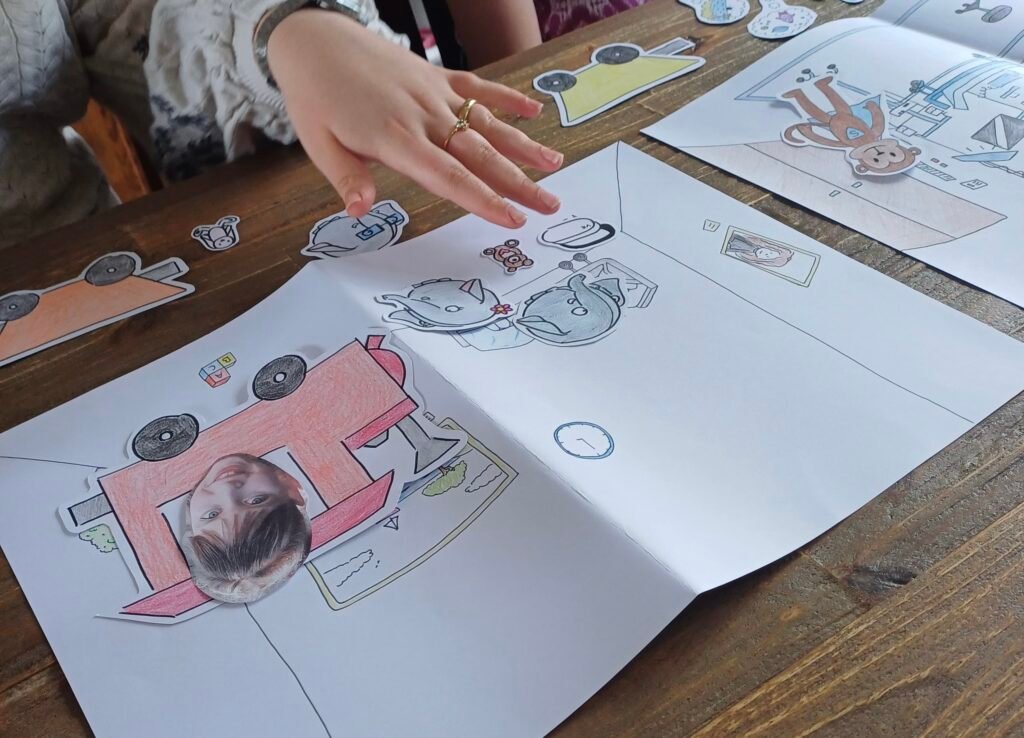
Our first prototype was a paper prototype. We chose this format to quickly and clearly tell a story, as storytelling is a very important part of our concept. In our prototype we make use of many existing techniques that have already been researched and are often applied in practice. However, since these elements are quite separate from one another, the overall structure can feel a bit unclear. A story, on the other hand, can help engage children more deeply in the situation.
I tested this prototype myself, guiding the children through different spaces as the storyteller and highlighting their freedom of choice along the way.
The storyline can be seen in the video below.
Prototyping
After focusing on the storyline, it was time to create a real digital experience off our prototype. I built this in Fectar, which turned out to be a relatively easy tool for me to use. It allowed me to quickly design the first room, the operating room. After testing and improving this room with the target group, I used my skills to help my teammates understand how to work with Fectar as well.
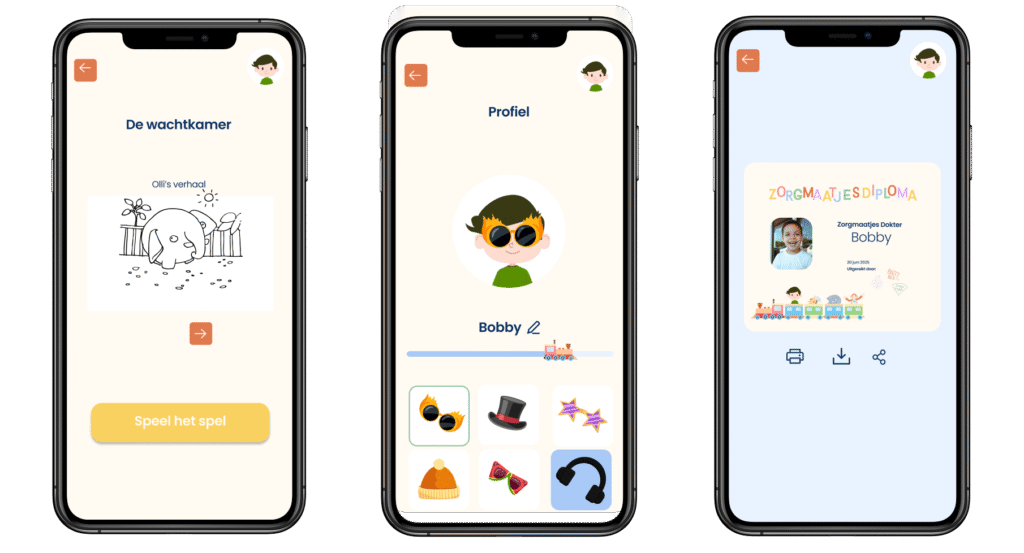
I also designed a app to help children navigate through the different VR elements. I continued the storytelling within the app by mapping out the route the children take. At the end of the experience, the children receive their own diploma, which provides a sense of closure and boosts their confidence.
Our Solution
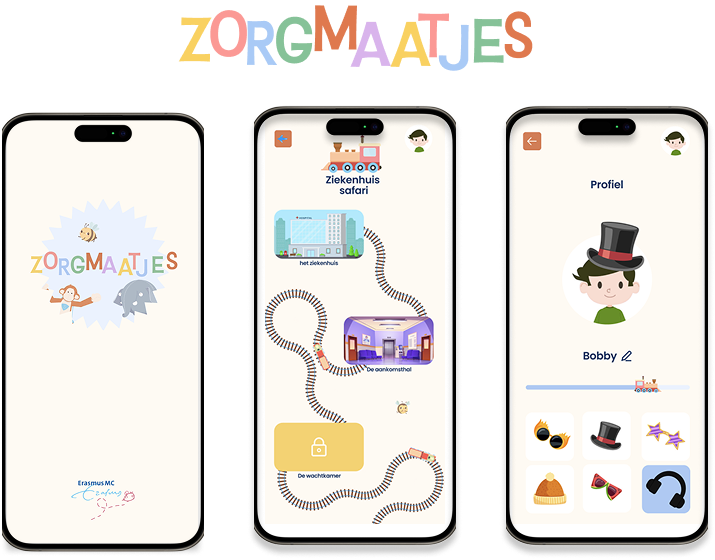
Our final result consists of a combination of the zorgmaatjes app thats connected to the corresponding VR world. Through VR, you can fully immerse yourself in the journey trough the hospital.
The app: you unlock different rooms and can customize your own avatar and decorate it with various accessories. Before entering a room, you receive an explanation about the situation. For example: Olli, one of the zorgmaatjes and the mascot of the Sophia Children’s Hospital, has tripped over a banana. What will happen to him now?
The VR headset: you become completely immersed in what awaits you at the hospital. You make different choices to help your care buddy. For example: In the waiting room you can help Olli choose whether he wants to bring his mom or dad.
Reflection
During this period, I learned a lot about applying new techniques. I taught myself how to create a VR experience and had the opportunity to further develop my skills in Figma by designing an app and using a design system. I also gained insights into storytelling and its impact on children.
Looking back on this project I would have explore the different techniques we could use more during the research phase. I would have liked to learn more in advance about the effects of these techniques on children, as we mainly focused on the techniques already applied in hospitals.
With more time, I would have liked to further develop the journey within our prototype to make it easier to communicate and experience. Overall, I enjoyed working on this project, and I’m proud that we achieved third place in the audience award at our exhibition.
CMD year 2
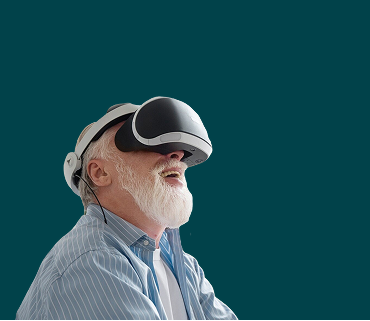
VerwonderAR
How can we offer elderly people with dementia a museum experience so that they can enjoy art and culture in a safe and meaningful way?
Dordrechts museum
CMD year 1

The Mirror Of Affirmation
“How can we support and inspire queer young adults to feel confident when choosing a haircut that reflects their personal identity?”
SOBKOLT