
How can an immersive experience such as VR contribute to preparing children aged 8 to 10 for their (anesthesia) treatment?
Children can experience surgery in a hospital as a traumatic experience that they remember for the rest of their lives. As a result, some adults tend to avoid hospital visits because of negative feelings associated with hospitals that developed in childhood. That’s why it is especially important to provide children with a positive and reassuring experience during their surgery.
Date: 1-2-2025 t/m 16-6-2025
Client: Erasmus MC – Create 4 Care
Grade: 8
my tasks: ux research, prototyping
Target group
Children between the ages of 8 and 10, without prior hospital experience, who need to go to the hospital for a surgery requiring anesthesia.
Children who need to go to the hospital for surgery often do not have a clear understanding of what this means. This can lead to fear and anxiety in children. It not only affects the surgery and recovery, but can also result in avoiding or postponing hospital visits later in adulthood.
Current Situation
Different elements play a role in the preoperative anxiety that children experience. For example, children may find it stressful to give up control. They may also lack a clear expectation of what will happen, which can create tension. Hospitals have already introduced many initiatives to help both parents and children prepare for treatment. For instance, there are books, websites, and apps available to support children in their preparation. There is also being experimented with virtual Reality (VR), and it’s already used as preparation or distraction. However, this is still applied on a very small scale.
Design proces

Research
During this period, I mainly focused on the target group: children with little or no experience of being in a hospital. To explore this, I organized a creative session with four children where we talked about the image they have of the hospital. We did this by drawing and writing everything that came to their minds on large sheets of paper. It became clear that their perception of hospitals was largely based on what they had seen and heard in their surroundings, like someone in there klas that broke a arm.
The children also came up with their own inventions designed to comfort kids in hospitals. Most of these ideas involved toys stuffed animals, but many also centered around family and friends. I was able to combine this research with interviews with experts, such as a child pedagogue from the Sophia Children’s Hospital, as well as existing research conducted by Erasmus MC.
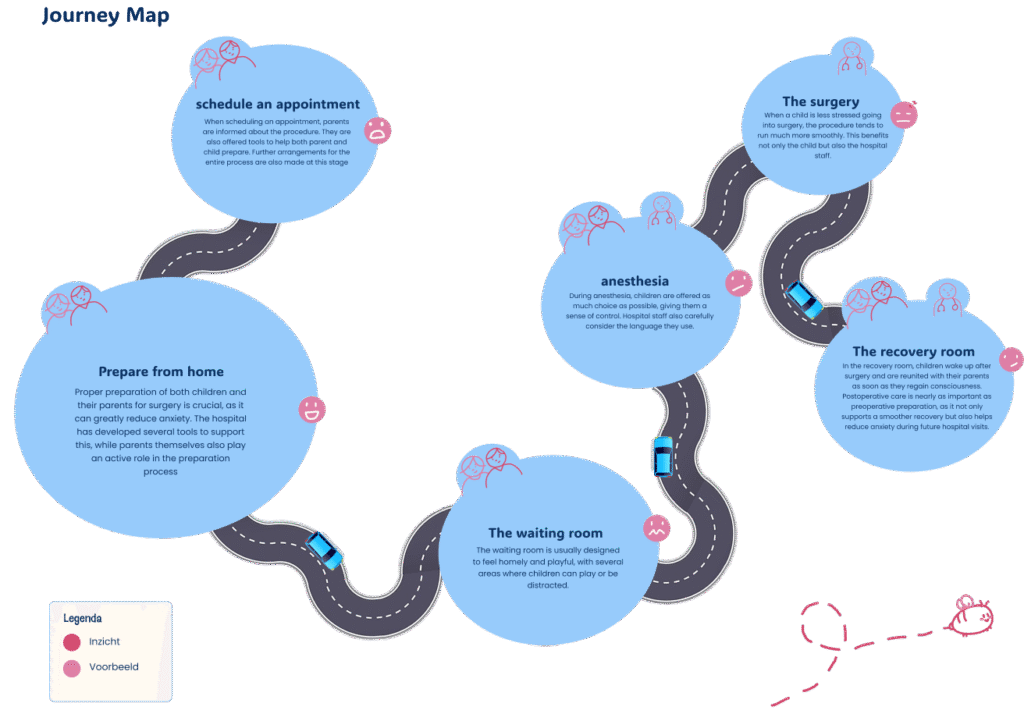
This image shows the roadmap I created to map out the current situation from start to finish.
Prototyping
After focusing on the storyline, it was time to create a real digital experience off our prototype. I built this in Fectar, which turned out to be a relatively easy tool for me to use. It allowed me to quickly design the first room, the operating room. After testing and improving this room with the target group, I designed the waiting room to visually support the storyline.
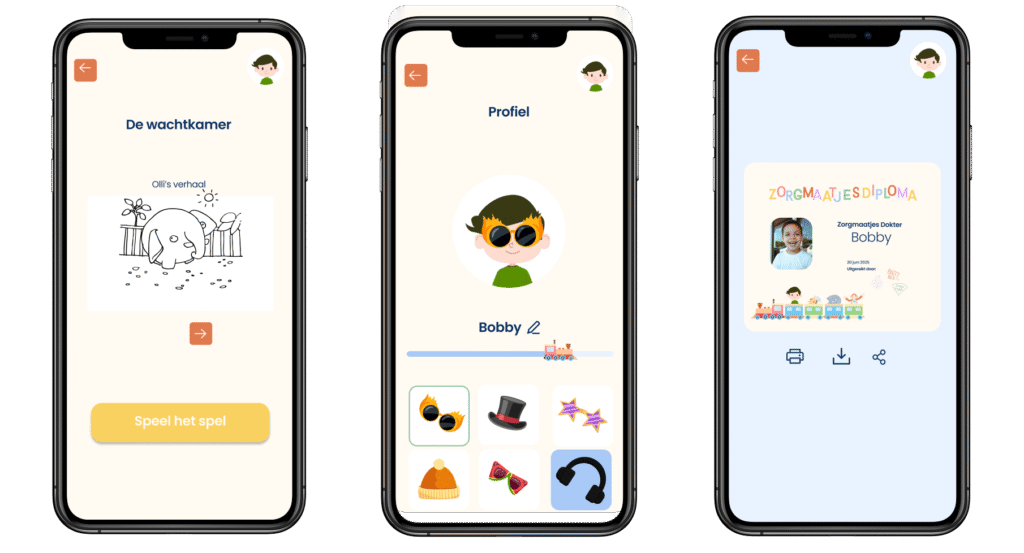
I also designed a app to help children navigate through the different VR elements. I continued the storytelling within the app by mapping out the route the children take. At the end of the experience, the children receive their own diploma, which provides a sense of closure and boosts their confidence.
Reflection
During this period, I learned a lot about applying new techniques. I taught myself how to create a VR experience and had the opportunity to further develop my skills in Figma by designing an app and using a design system. I also gained insights into storytelling and its impact on children.
Looking back on this project I would have explore the different techniques we could use more during the research phase. I would have liked to learn more in advance about the effects of these techniques on children, as we mainly focused on the techniques already applied in hospitals.
With more time, I would have liked to further develop the journey within our prototype to make it easier to communicate and experience. Overall, I enjoyed working on this project, and I’m proud that we achieved third place in the audience award at our exhibition.